


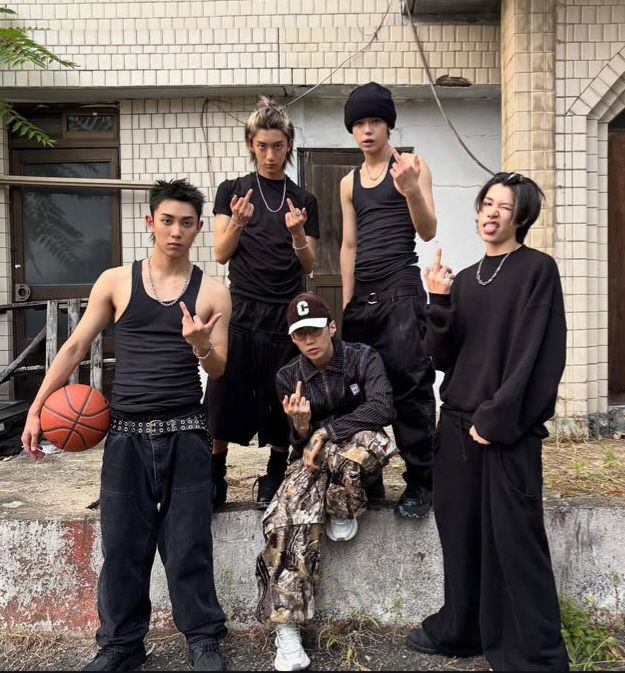
Picture this: four rookies on the verge of their debut in the Korean music industry decide to introduce themselves by firmly flipping the bird at the camera. It was a gesture of overt defiance that immediately set social media ablaze, polarizing public opinion between those who dismissed it as “try-hard” and those who saw a refreshing dose of raw insolence. This is where the most fascinating narrative short-circuit occurs: their founder, the legendary Jay Park, is framing this very group as his direct response to the fact that “K-Pop has lost its romantic spirit.“

According to Park, the industry is navigating a phase of profound existential reflection. The current system has become overly “standardized” and is desperate to rediscover the sincerity of those who don’t feel the need to please everyone, but rather demand respect for who they are. For Park, romance doesn’t reside in finger hearts, but in the freedom to pursue what one loves without bending to market trends.
January 2026: Double Drop
The LNGSHOT launch strategy shattered every rule in the K-Pop manual, saturating the market with two distinct yet complementary projects in less than a week.
1. The Debut EP: Shot Callers
The title is a statement of intent: these are the people who set the rules. Hard to misinterpret, right? The members were deeply involved in the creative process, contributing to the lyrics, composition, and arrangement of four out of the five tracks.
-
- Moonwalkin’: The lead single is an explicit homage to Michael Jackson. The metaphor of the iconic dance move—moving forward while sliding backward—describes the anxiety and uncertainty of their trainee days, balanced by a relentless drive to emerge. It was originally intended as a solo track for Woojin.
- Never Let Go: The soul of the record. This is the only track where all four members collaborated simultaneously on writing, music, and production, serving as the definitive symbol of their internal cohesion.
- Saucin’: Pure energy—with a side of chaos—this pre-release track carved out the group’s edgy aesthetic from the jump.
- FaceTime and Backseat: Pure R&B, showcasing a vocal maturity and a studio-focused sincerity that Ryul describes as their most mature side yet.
2. The Raw Essence: 4SHOBOIZ MIXTAPE
If the EP is the official calling card, the 4SHOBOIZ MIXTAPE, released just days later, is the embodiment of “realness.” Comprising ten tracks, the project was a direct response to fan demand for a less polished, hip-hop-centric sound. It features viral standouts like Are You Ready and Next 2 U (Carol Remix). The group isn’t afraid to experiment with breakneck tempos and improvisational styles, underscoring that LNGSHOT was born as a crew, not just an idol group.
Meet the LNGSHOT Crew
Louis
Louis Elliot Jourdain Lim (born 2010) is the maknae and already a media phenomenon. Standing 186cm tall and of Korean-French descent, he is fluent in Korean, French, and English. But it’s his timbre that has fans obsessed: many have noted a striking resemblance to early Justin Bieber—a crystalline, slightly androgynous pop tone that is rapidly evolving as he comes of age. Jay Park himself praised Louis for possessing a rare vocal color that “cannot be taught.”

Ohyul
Kwon Oh-yul (born 2006) serves as the leader and the group’s anchor. A former KOZ Entertainment trainee (Zico, BOYNEXTDOOR), he spent five years in the system before landing at Jay Park’s MORE VISION. His routine is near-ascetic: a daily 5km run and intensive physical training sessions that have earned him the moniker 5km_salmon. He is also a Rubik’s Cube whiz, capable of solving it in under a minute—a detail that speaks volumes about his mental agility.

Ryul
Kim Ryul represents the group’s pure hip-hop soul. Already well-known for his stint on the survival show RAP:PUBLIC, he is considered the team’s “mood maker.” Jay Park proved to be a notoriously rigorous mentor to him, reportedly drilling him for 15 consecutive minutes on the correct pronunciation of the single word Shot to ensure a flawless international impact on their global tracks.

Woojin
Jeong Woojin is the “maker” of the group. With six years of training under his belt (including a stint at BigHit), Woojin possesses a visceral understanding of performance. Beyond his composition skills, he is known for eccentric physical talents—ranging from spectacular scapular control to high-precision basketball handling.

The Jay Park factor
Jay Park, the mind behind the crew and founder of MORE VISION, doesn’t just play the role of CEO. His management style is a direct reflection of twenty years spent dismantling stereotypes: from an Asian artist in American hip-hop to a “disruptive” idol in Korea, frequently targeted for a style that “unconventional” barely begins to describe. This experience has forged his ultimate goal: not to churn out another packaged k-pop product, but to build a team that earns respect through authenticity.
To achieve this, Park has established a horizontal relationship—a “human-to-human” bond where the boss blurs into an overbearing older brother. His mentorship manifests in jarring ways, like flooding the group chats with workout videos or “body checks” to motivate them through sheer physical flexes. The members, caught between respect and secondhand embarrassment, admit to frequent ghosting just to manage these outbursts of physical pride. Yet, this proximity allows for a rare level of confidence; they aren’t afraid to tear apart his awkward attempts at aegyo on TV or his fashion sense, mockingly dubbed Wonsun-style.
This obsession with inner strength is what drove the “middle finger” pre-debut imagery. For Park, it was a pedagogical move: expose the artists to the crossfire of public criticism immediately to build mental armor. “I don’t know if they’ll sell more, but I’m sure they’ll do k-pop the coolest way,” he stated, backing them with the hashtag #middlefingertothenorm. To complete this “resilience school,” he even trained them in over-the-top, B-movie style acting, teaching them not to take themselves too seriously and to safeguard their spontaneity.
Park’s vision for LNGSHOT ultimately distills down to sincerity as a form of loyalty to oneself. The most valuable lesson he has imparted to Woojin and the rest isn’t about choreography or hitting notes, but the very essence of being an artist: staying consistent even when the cameras are off.

The “Creator Generation”: LNGSHOT & CORTIS
The industry is witnessing the swift and decisive ascent of the Creator Generation—a significant paradigm shift where the emphasis of the entire artistic project has moved beyond mere stage performance toward total creative direction. Within this creative landscape, LNGSHOT and BigHit Music’s CORTIS operate as parallel forces, creating a generative dualism that, in my view, ought to force a total pivot for the fifth generation.
Both collectives are dismantling the traditional idol blueprint, operating instead as “creator crews” where every member exerts direct control over production, sound, and—in the case of CORTIS—visual identity. Their identities move along distinct trajectories: while CORTIS aim to “Color Outside The Lines” through sophisticated production deeply embedded in the HYBE ecosystem, LNGSHOT stake their claim on a rawer “realness,” born from a desire to prioritize emotion and risk over the clinical precision of market formulas.
The musical contrast is stark. CORTIS lean heavily into rage trap, channeling the energy of Travis Scott and Playboi Carti to inject a dark, urban grit into the heart of Korean pop. LNGSHOT, while anchored in hip-hop, pivot toward R&B and Pop, with a melodic aesthetic that echoes the early silkiness of Bieber and Jay Park’s own discography. Both collectives are stocked with talent that was already influential pre-debut: CORTIS features Martin, who has penned tracks for TXT and ILLIT, while LNGSHOT’s Ohyul and Louis have already logged hours co-writing for Jay Park. Ultimately, it is this divergent take on “sincerity” that will turn their parallel rise into a defining case study for Korean music in the years to come.


LNGSHOT aren’t chasing perfection; they’re here for “realness.” Between a maknae with a Bieber-esque lilt, a leader who clocks 5km a day, and a boss pushing for raw rebellion over manufactured sincerity, they represent one of the boldest gambles in contemporary K-pop.
Their moonwalk is the definitive metaphor: a movement that draws from the past, captivating the audience while moving against the grain of the mainstream. The real question is whether, by sliding backward, they can actually pull the entire industry one step forward.
Source: Koreami






Leave a Reply